
One of the first things students ask me when they start learning astrology is:
“Sir, is Saturn’s transit bad?”
Or,
“Jupiter is transiting my Moon. Does that mean everything will become perfect?”
I understand why these questions are so common. We all want simple answers. We want to know whether the coming year will be fortunate or difficult. But after years of studying astrology and analysing hundreds of horoscopes, I have realised that reality is much more interesting than simply labelling a transit as “good” or “bad.”
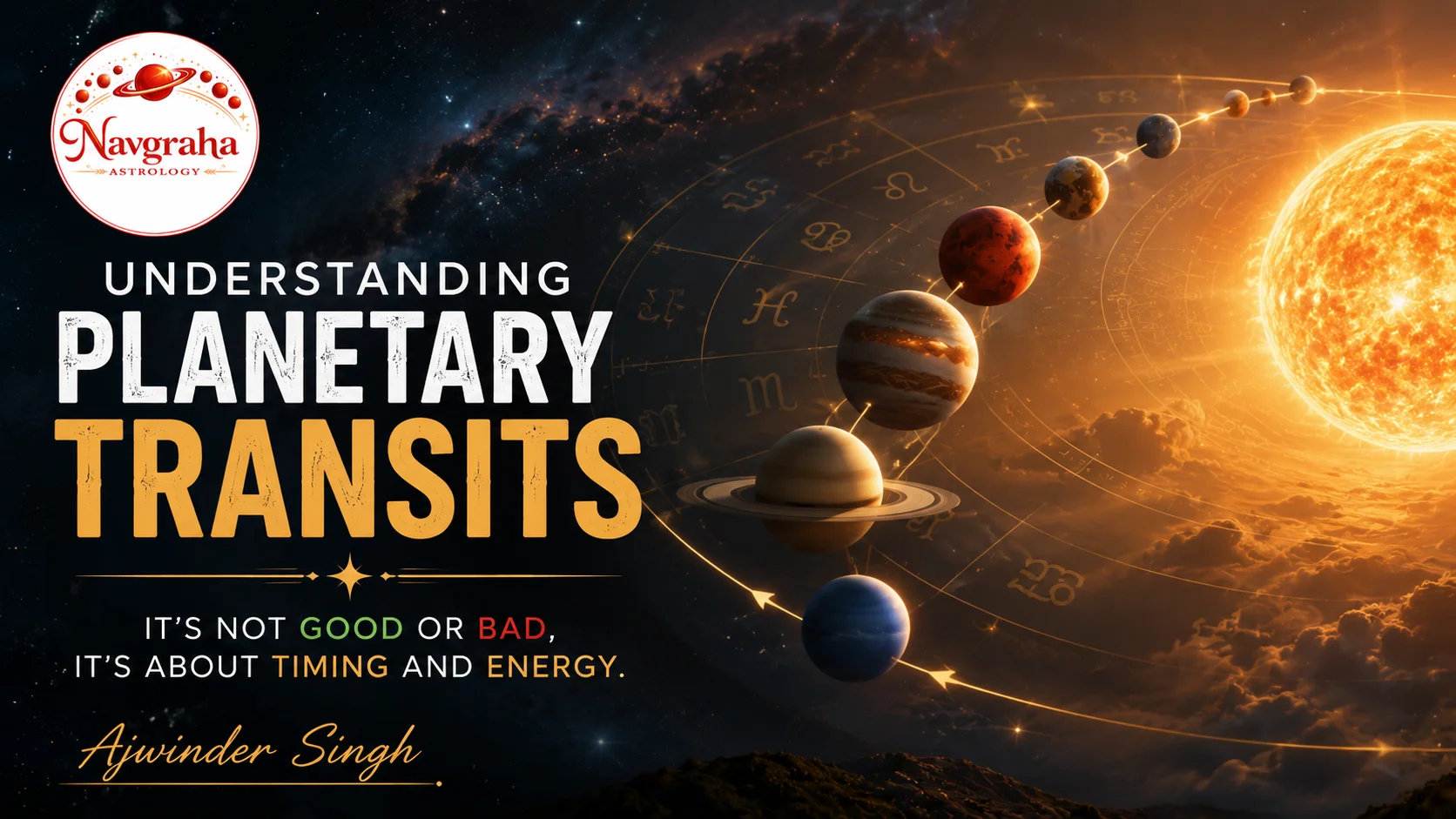
In my opinion, a transit should be understood as the activation of a particular planetary energy, not as a guarantee of a specific event.
The Same Transit, Different Results
Let me give you a simple example.
Imagine two employees working in different companies. Both of them are going through a strong Saturn transit.
The first employee has been avoiding responsibilities for years. Deadlines are constantly missed, work is incomplete, and discipline is lacking. For this person, Saturn may bring pressure from the management, criticism, or even the loss of a job.
Now look at the second employee. This person is punctual, works sincerely, and is willing to take on additional responsibilities. During the very same Saturn transit, that individual may receive a promotion because management finally recognises years of consistent effort.
The planet did not change.
The transit did not change.
The response to Saturn’s energy was different.
This is why I always tell my students that planets do not reward or punish us. They simply bring certain lessons to the forefront of our lives.
A Transit Doesn’t Start Outside—It Starts Within
One mistake many beginners make is waiting for something dramatic to happen.
Whenever a major transit begins, people expect an immediate event.
In reality, many important transits first change your thinking before they change your circumstances.
Suppose someone enters a Jupiter period.
The first change may not be a promotion or an increase in income.
Instead, they may suddenly develop an interest in learning, spirituality, or higher education. They begin reading more, meeting knowledgeable people, and thinking differently. Months later, those inner changes naturally create external opportunities.
The outer event often follows the inner transformation.
Why Difficult Periods Can Become Blessings
I have often noticed that people fear Saturn, Mars, or other challenging planetary influences.
But think about life itself.
Does a student become successful by studying only when they feel comfortable?
Does an athlete become stronger without training?
Can a business grow without facing competition?
The answer is obvious.
Growth requires effort.
Many of the strongest people I have met did not become successful during easy periods. They became successful because difficult times forced them to become wiser, stronger, and more disciplined.
Astrology reflects this same principle.
Some planetary periods ask us to expand.
Others ask us to mature.
Both are necessary.
The Birth Chart Always Has the Final Say
Another lesson I repeatedly share with my students is this:
Never interpret a transit without studying the natal chart.
The birth chart shows the promise.
The transit shows the timing.
Imagine a seed.
If you plant a mango seed, no amount of rain will produce apples.
The rain helps the seed grow, but it cannot change its nature.
Similarly, a transit activates what already exists in the birth chart. It cannot create something that has no foundation.
This is why two people experiencing the same planetary transit often have completely different life experiences.
My Advice to Every Student of Astrology
Do not fear transits.
Do not become overconfident because of a so-called favourable transit.
Instead, ask yourself:
What is this planet asking me to learn?
When you begin asking this question instead of simply predicting events, your understanding of astrology changes completely.
You stop seeing planets as forces that control your life.
Instead, you begin seeing them as guides that reveal the natural rhythm of your journey.
That, in my opinion, is the real purpose of studying planetary transits.
– Ajwinder Singh
